
My Simple Method for Batching Tasks to Maximize Efficiency
Imagine gaining back hours each month without delegating, cutting back, or automating your tasks. It’s like free time that’s yours for the taking.
This not-so-secret weapon is a strategy that all creative entrepreneurs have at their disposal, and it’s called batching.
It’s the king of task management, yet this effective trick is so simple you can master it in 3 easy steps. If you try it out, I guarantee you’ll benefit from this approach to getting things done.
Learn how in today’s post, and start saving time so you can focus on the projects you’ve been wanting to work on.
What is Batching? And Why Batch Your Business Tasks?
The term “batching” refers to tackling your tasks in bulk. So instead of sitting down once a week to write one newsletter, for example, you write four of them at once. This frees you up to focus on other things for the rest of the month.
When done strategically, batching can give you back hours of your day.
How? It cuts out the repetitive, in-between tasks that you normally do over and over again. These include steps like opening your document to write, logging into your email list software, hunting down resources and links, scheduling your emails, toggling from one app or program to another, etc. When you approach tasks in bulk, the repetition of many of these steps are cut back or eliminated.
Batching also allows you to stay in a productive work rhythm since you are able to keep your focus on one task instead of juggling a bunch in a small amount of time. It also gets rid of the unproductive warm-up time that it often takes to get into a deep working rhythm each time you switch to a new task.
Batching is a great way to get ahead with your tasks, too, because you complete them in bulk before they are actually needed to be done. Plus, you don’t need to refresh your memory each week, figure out where you left off, or try to recall the points you wanted to get across.
This technique also frees you up to work on new projects or other high-impact areas of your business that are often difficult to get to.
Areas to implement batching in your business:
content brainstorming
blog post outlining and writing
blog post graphics
newsletter writing and setup
podcast and video recording
social media posts
client work
product creation
bigger projects
emails
How to Batch Your Business Tasks in 3 Simple Steps
1 // List out all of your tasks
To start, make a list of your tasks for the next month. For each item, denote whether it is repetitive or a one-time task. This will give you an idea of the tasks you can continually accomplish in bulk.
The more intentional you are with this step, the more your business will benefit from batching, so make sure these tasks lead to your goals instead of take up your time. Look at your plan for the month to double-check that you’re sticking to the right path. Then, cross off any tasks that don’t apply, and add any that you may have overlooked.
Pro Tip: I create an action plan when I set goals, so I already have an idea of the tasks I need to do, such as the type of content I need to create and the marketing strategies I want to try.
When I create a batch list, I go through all of my goals and walk through what I need to do step-by-step to make sure I cover all of the tasks.
Once you’ve confirmed that your list of to-do’s (or must-do’s, as I like to call them) is complete, think about each one and break them down into small action steps. An action step is a one-step task that spells out each part of of a task or a goal.
For example, you might have “publish 2 blog posts each week” on your list, but it’s best to break down the process of writing a blog post into different pieces. You could list them out like this:
Brainstorm topic ideas
Outline post
Draft post
Write post
Edit post
Determine title and url
Determine categories and tags
Do this for all of your tasks and projects until each one is broken down into small one-off steps.
2 // Organize your tasks into batching groups
Once you have a list, you’ll have a complete picture of all of the kinds of tasks you can group together and accomplish in batches.
To create groups that make sense for batching, organize your tasks into similar types. The way you group them is up to you, so play around with how you organize it to find what works best for you.
For example, anytime you see an action that begins with “write,” you can add it to a “writing tasks” group that can be tackled in bulk. Here you can list things like blog posts, newsletters, and instagram captions. This lets you focus on and complete all of your writing tasks together in one batch.
Or you can split up your writing into separate batches for content creation and marketing copy if you want to keep blogging separate from instagram captions and tweets.
You can even batch brainstorming for all of your platforms (idea generation for blogging, newsletter, podcast, videos, social media, etc.).
Or you can keep platforms separate and tackle each one in its own batch (create and schedule blog posts, write and schedule newsletters, outline and record podcasts, plan and schedule social media posts, etc.).
The great part about batching is that you can always tweak your system a bit as you try it out. The goal of batching is to cut out repetitive steps, save time, give you focused work sessions, and let you stay ahead of the game. So keep that in mind as you formulate your batches.
3 // Create a schedule for batching
Next, decide how much batching you want to do at once. Do you want to spend an entire day on one type of task? Or do you want to fit a few smaller batch sessions into one day? Do you want to batch as many tasks as possible? Or do you only want to batch a particular few?
Try to find the perfect range where you can work with a deep focus on one task for a long chunk of time without hitting the limit where you overdo it and lose concentration.
Batching takes some getting used to, and there will likely be some trial and error to find your sweet spot. Don’t be afraid to push yourself a bit at first, but avoid going too far or wearing yourself out.
It’s helpful to regularly take short breaks when working on one task for a long spurt, so be sure to include rest time in your schedule as well.
You can approach your batching calendar in different ways:
A few focused sessions of batching each day
One or two batch days each week
A full week or a half-week of batching each month
A set number of batching days each month
You can sprinkle batch days around or burst through them back-to-back. Create a routine that works best for you and your tasks.
So there you have my 3-step system for how to batch.
Have you ever tried batching your business tasks? I’ve found it to be incredibly helpful, and I’m amazed at how much time this strategy has saved me. It’s so simple, and I enjoy working on my tasks even more since I am able to be more efficient.
I would love to know your thoughts in a comment below!

Going into the new year, I had a refreshed perspective about planning.
Because in 2020, I let some of my goals go without stressing about it. I took some time off to enjoy several other creative hobbies I hadn’t done in a while.
After a few months of making polymer clay earrings, doing home decor projects, and working on my fiber arts brand, I dove back into my Ponder Trail business tasks. But this time, with a different mindset.
It was still 2020, after all, so I decided to just take it day by day without planning or setting too many goals.
But what happened surprised me: I ended up checking off more things on my to-do and projects list than I had expected. My productivity somehow increased, and I achieved several goals earlier than I’d originally intended.
I launched my first few digital products for Ponder Trail, officially opening the entrepreneur resource shop that’s been on my list for a while now. I brought on new clients. Blogging became easier than ever. And all without following a rigid schedule or routine. It kind of blew my mind.
After some reflecting, I realized what had changed: I spent less time over-thinking, balancing all the things, and maintaining the status quo. And instead, I spent more time doing high-impact tasks, focusing on only 1-3 goals at once, and prioritizing project-creation.
I had much more clarity, and my productivity increased drastically once all of the extra things were off my plate and weren’t competing for my attention.
So going into January this year, I knew I wanted to restructure the way I tackle tasks, using my 2020 findings as a jumping-off point.
The main hang-ups that linger in the background of managing business to-do’s are typically (1) not feeling prepared enough (hence not taking action), and (2) feeling torn in too many directions (hence not being able to stay focused).
I knew plans and strategy were still they key to getting things done, but I wanted to simplify things and be more efficient.
I needed to find a way to still work towards my desired goals while also have less to manage at a time—and fast: I had no plan, and it was already one week into January, and my first launch for the year was fast approaching.
And then, I had an idea . . .
When overwhelm starts to show it’s ugly head, it’s time to take action and stop it in its tracks.
If you’re feeling overwhelmed, it might be a sign that something isn’t quite right.
Sometimes it can be out of our control, but often times, it’s tied to how we are approaching our business and managing things. If you’ve been spinning your wheels or find yourself stuck in a cycle of trying-and-failing, it’s time to take control.
Overwhelm can quickly lead to burnout if it hasn’t already.
But not to worry, I have your back with some tried-and-true strategies.
Try these tricks to put overwhelm at bay.
We’re all spending more hours working in our houses these days.
But it isn’t always possible to dedicate a space in your home for your business. Sometimes a work area looks like a the kitchen counter, coffee table, or couch, and with a little creativity, your home probably has a few great places to hunker down and get work done.
The goal of any workspace is to be a productive setting to get work done. And when we’re hustling hard or working on a project, it’s usually best practice to create some sort of setup to help your work sessions be efficient.
But when you don’t have an office or a desk, you might not want to leave your stuff set up round the clock.
The key is finding the right balance. You want your workspace to be quick to set up and easy to tear down. Otherwise, the process takes time away from your day and creates a hundred extra steps between you and getting to work.
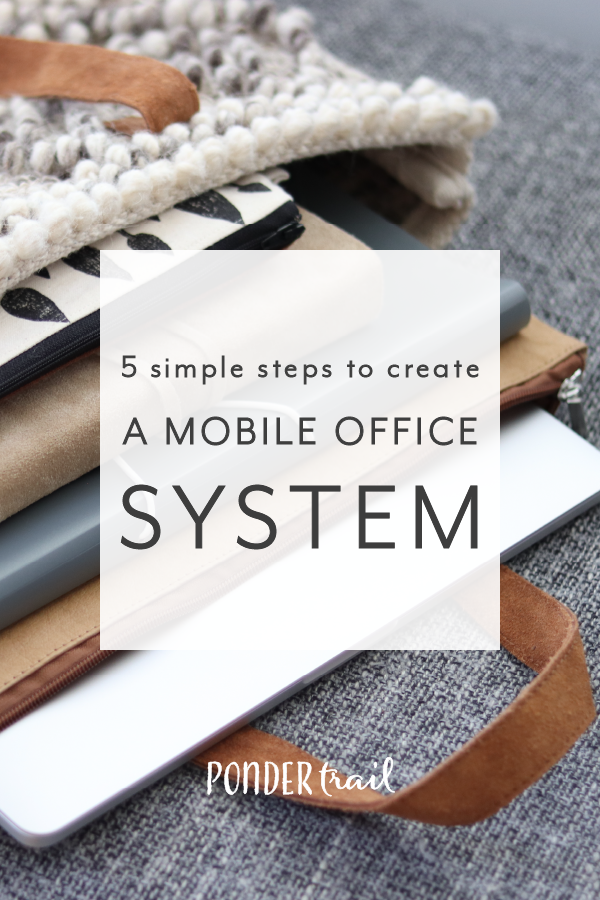
What’s the solution? You need a mobile office system.
This summer, I came up with a simple way to pack up my office to work productively from anywhere.
My friend and fellow creative, Caitlynn, requested this blog post, so I made it a little extra special by including lots of images. In fact, I did a photoshoot so I could show you exactly what I use. I hope you enjoy the tutorial!
Over the past few years, I’ve discovered the value of adopting a laser-focused mindset. It creates clarity and an open runway to brainstorm and bring your ideas to life. It gives you space to think strategically, create a plan, and stay on track. It cultivates productivity, action, and progress like nothing else.
Once I switched my approach and dedicated my attention to one part of my strategy, I started saving time, seeing more progress, and finally getting in the groove. And I haven’t looked back since.
I started seeing the difference it made in my business first-hand, so I set out to help other creatives do the same. And after coaching brand strategy clients one-on-one for over a year, I wanted to find a way to help even more creatives.
So I landed on the perfect idea: a self-paced membership program. It’s a brand strategy subscription that’s part-course, part-service, and part-library, so it meets the best of all worlds for entrepreneurs who are looking to take action in their businesses.
I’m calling it the Brand Strategy Treehouse.
It’s my all-new signature membership, and it’s available to you today!
During the hiatus I took this spring, I spent some time brainstorming new content ideas for the rest of the year.
And today, I’m excited to introduce the latest resource to Ponder Trail: videos!
I wanted to try switching up the format for how I give tips for creative business and brand strategy, and what better way to share it that with video?
I will be uploading to the blog and my YouTube channel twice a week, on Wednesdays and Fridays. Each time I upload a video, I will add it as a new blog post with all of the info mentioned in the video.
Since I love talking about productivity and working from home, I figured it would be the perfect video to start with. I hope you enjoy!
The ultimate goal of productivity is to get rid of busyness and replace it with efficiency, effectiveness, and progress.
As creative business owners, hustling often works its way into our lifestyle. We have so many ideas and things to do. But sometimes that mentality pulls in too many things that aren’t actually helpful or productive in the long run. On the outside, it can look like we’re getting lots done, while in reality, we’re running around in circles.
Don’t simply add to your hustle for the sake of feeling busy. Instead, you want to see progress from the time you put into your business, and you want your time to have a big impact. True productivity looks like speeding along the process of reaching your goals or helping you stay on track.
Here’s how:

While many creative entrepreneurs have already been working from home, in recent months, people around the globe have faced strict social restrictions and isolation orders. This has taken away the much-needed work days at coffee shops that entrepreneurs often rely on to stay productive and to get out of the house throughout the week.
With productivity in jeopardy from being stuck at home for months on end, it's easy to slow down, get behind, or take days off unintentionally—simply because your drive to work has dwindled. But when starting, running, or scaling your own business, it's critical to keep working and getting things done.
So what is an entrepreneur to do when their livelihood is tottering at the top of a mountain along with their close-to-plummeting motivation?
You've got to push through and boost your productivity so you can get tasks done!
So here are 11 of my favorite work-from-home essentials to stay motivated and get back into the groove.

When you run your own business, it’s easy to leave your day open and unstructured because you can, right? But it’s also easy for that openness to become filled with nothingness.
And that’s where a schedule comes in to save the day. Structure is a key part in a productive day, and I’m here to share one of my favorite methods of organizing my time as a creative business owner.
It’s called time blocking, and it is why I’m sitting here today writing this blog post to help you on your entrepreneurial journey. Because without this system, my productivity would have flatlined a long time ago.
If you’re hoping to schedule your workweek and start being productive, this post is for you! (Plus, I’ve included a copy of my free goal-planning workbook, complete with a few pages dedicated to helping you schedule your week.)
Imagine gaining back hours each month without delegating, cutting back, or automating your tasks. It’s like free time that’s yours for the taking.
This not-so-secret weapon is a strategy that all creative entrepreneurs have at their disposal, and it’s called batching.
It’s the king of task management, yet this effective trick is so simple you can master it in 3 easy steps. If you try it out, I guarantee you’ll benefit from this approach to getting things done.
Learn how in today’s post, and start saving time so you can focus on the projects you’ve been wanting to work on.

Working from home is a huge blessing that comes with having my own business. And while most of the time it’s amazing, it does pose its own challenges.
Common struggles among creative entrepreneurs living the work-from-home life often include managing time, limiting distractions, and avoiding the dreaded cooped up feeling.
Over the course of five years of working primarily from home, I’ve tried countless methods to overcome these hangups—and boy did they plague me when I was first starting out.
After all of the trial-and-error, I’ve honed in on the top strategies that made running an online business from home a magical experience.
So here are 11 simple practices I follow to help me stay productive each day.
Setting and reaching a goal consists of 3 main stages:
the part that depends on your time, resources, and tools
the part that relies on your know-how and abilities
the part that counts on you doing the work
These areas each create their own hurdles around achieving goals. Over the years, I’ve struggled with all three of the hang-ups above, and today I’m sharing my best insights on how to overcome them.
With goals, we either tend to overaim with excitement or under-aim with overwhelm. Both often result in feeling stuck. But instead, we need to find the right balance to bust through roadblocks like these.
Good news is, goals are infinitely easier to set and achieve with you are equipped with the right tools in your pocket.
If you are struggling to start or grow your creative business, don’t extinguish your dreams before you have a good run! Give it your best shot with the tips in today’s blog post.

Are you making headway on your goals? Are you staying on track? Or do you often find yourself missing the mark and rewriting the same goals at the top of next month’s planner pages . . . again?
In my last post, I talked about the simple missing link to reaching goals, and I explained why many goals always seem to get away from us or feel out of reach.
Today, I’m showing you how to apply that secret so you can finally break the cycle of pushing your goals into the future.
If you tend to rewrite the same to-do list week after week, these 4 simple steps will help you understand and overcome the common struggle that many creative entrepreneurs face: how to actually reach goals.

Goals.
We set them. We plan them. We reach them, too.
Or at least, we hope we do.
Some goals propel our business forward and help us reach new grounds, while others are critical for simply keeping our business above the water.
There’s something thrilling about reaching a goal—especially after working hard for it day after day. The feeling you get when you finally check one off of your list creates a strong sense of accomplishment and a surge of motivation.
But it can be quite discouraging when you find yourself transferring the same unmet goal over to next month’s planner pages, time and time again, to no avail.
“Maybe next month will be different. Maybe I’ll finally check that one off,” we hope, once again.
But when we are stuck in a cycle and struggle to reach our goals, it’s time to try a different approach.
Last January, while thinking deeply on this subject, I had an epiphany. I figured out the secret to reaching goals—or at least the key I had been missing for years.
I realized there were actually two distinct types of goals, and I was completely missing the mindset behind one of them.
It completely transformed the way I think of goals, how I set them, and how I map them out as a creative entrepreneur.
This blog post sheds light on that secret, and I can’t wait to share it with you!

What do you love most about a good workspace? For many creative entrepreneurs, it’s natural light, a clutter-free feel, a lack of distractions, and cozy, comfy vibes. These all work together to create an inspirational space that allows us to work productively on our businesses.
Whether you have an entire office at your disposal or a tiny corner in your living room, today I’m sharing 10 simple steps for creating an enjoyable workspace—no matter your setup.
If you want your work zone to feel like a productive retreat you get to return to each day, let this blog post be your guide.
video + blog post
In my last Ponderstream Episode, I shared my step-by-step process for how I reach my goals. My process includes creating goals, breaking them down into daily actions, and monitoring your progress along the way.
Over the past year, I’ve focused on creating an effective and streamlined goal-planning system that saves time. Setting goals can be an easy place to get hung up on, so I wanted to outline a specific method that I could follow over and over again.
My goal was to be able to incorporate a step-by-step planning system into my routine to eliminate the pitfall of wondering where to start each day or what to work on next.
After over a year of experimenting and refining, I’ve ended up with a simple goal-planning process and created a workbook to go along with it. It’s made such a difference with reaching my goals, so I was excited to share it with you all last week in my livestream.
Essentially, my method for reaching goals is breaking them down all the way into simple to-do tasks that are assigned to each day. This creates a step-by-step plan for staying on track so you can monitor your progress and actually complete the tasks necessary to accomplish your goals.
There are 4 main sections: prepwork and laying the foundation, setting goals, planning them out, and following through. Join me as I walk you through the entire process in detail.
Missed joining this one live? Register for next week’s Ponderstream webinar here.

Turns out, when I don’t have a schedule to follow, time leaks through my day like a siv.
. . . And I have a hunch I’m not the only one.
When I first began working on Ponder Trail, my mornings started at the early hour of 4:30am. I’d wake up and hit the ground running after my husband headed to work. Those morning hours were golden for being productive and making progress. And it was easy to spend 12 hours getting things done and getting my little company up and running.
Since then, though, our schedule has changed quite a bit.
After shifting to a later, and somewhat unconventional, schedule, it took a while to figure out a routine that was optimal for running my business. It often felt like I couldn’t get anything done or stay focused.
But I took it as a creative challenge, and over the last few months, I’ve been extra determined to create a daily routine that optimizes productivity and is easy to follow.
I’m happy to report that experimentation and persistency were just the ticket: after much determination, time-tracking, and habit-building, I landed on a new daily routine and work schedule that exponents productivity! In fact, it’s been my most effective work schedule to date.
I’ve been fine-tuning it ever since, and today, I’m taking you behind the scenes to see what a typical day of working on Ponder Trail looks like.
Keep reading for a tour of my routine and how I schedule my time.

A new quarter is the ideal time to check in with your business to maximize success. I always find quarterly segments to be perfect for finding clarity, setting goals, and staying on track throughout the year.
Their 90-day time span allow for progress to be made and give you ample time to effectively analyze the ins and outs of your business.
It’s all-too easy to drift from your course and lose sight of your brand’s focus, so in today’s blog post, I’m offering some help.
Ensure game-changing progress over the next three months with just four simple things to do at the start of each quarter.

Planning Instagram content 30 days in advance has many benefits.
It allows you to create and prepare everything so you only need to spend a few minutes on Instagram each day.
It helps you to “show up” consistently without Instagram becoming your full-time job.
It saves so much time and lets you create an Instagram routine that works with your busy life.
And, you never again have to stress out about throwing a post together last-minute.
If you’re wishing for a better posting strategy, or if you’re just curious about this whole “planning” thing, you’ve come to the right place. Because today, I’m sharing my simple step-by-step process for intentionally planning 30 days of Instagram content.

It’s that time of year again—when everything feels fresh and new. Goals swirl around our minds with ever-growing excitement about what we hope to accomplish in the new year.
We dream big about our businesses and can’t wait to get started on our latest and greatest ideas.
But without a methodical way to set and reach goals, there isn’t much hope for success.
So today, I’m giving you my step-by-step process to effectively plan for a successful and productive year. This is an in-depth blog post you won’t want to miss.

I wanted to try something new going into January this year: get a head-start.
The first few weeks of January usually get away from me, and before I know it, I’m halfway through February.
So I brainstormed ways to set myself up for success this year, and I’m happy to announce it’s made a huge difference so far. They are strategies I plan to continue implementing for the rest of the year, and I recommend you try them out, too.
This is what I did:

Do you ever find yourself struggling to make progress? With countless distractions and ways to wander from the path, it’s easy to fall behind.
The ability to work in a productive capacity can make or break any business. In fact, much of your success likely rests in this skill.
I’ve been focusing on maintaining its momentum over the past several months, and in this mega-packed blog post, I’ve rounded up 17 ways I’m improving my productivity this quarter.
I guarantee you’ll want to start implementing some of these strategies today!

The first time I landed on Vanessa’s blog, Pursue Simple Joy, it only took about 5 seconds to realize how productive she is in her business! So I am thrilled to have her join me on the blog to share her insights and story with you all today!
Vanessa and her husband, Micah, are an inspiring resource for boosting focus and productivity through simplifying the unnecessaries.
Their blog is filled with thoughtful post-after-post about pursuing simplicity for a more joyful life. And it’s easy to see the benefits of their approach just by glimpsing at how much they get accomplished.
I was intrigued to learn more about Vanessa’s tips and methods for maintaining such high productivity levels, and I knew she was the perfect creative to invite on for my weekly Entrepreneur Highlight series.
This feature is jam-packed with so many easy-to-implement takeaways about running a small business.
For strategies that will supercharge your focus and productivity, keep reading.

This blog post is extra special because it’s the very first in my new Friday series: Entrepreneur Highlight.
Starting this week, I’m bringing on entrepreneurs from different creative industries to share their businesses, insights, and talents with you.
One of the things I love most about working with my clients is getting to know so many different creative entrepreneurs who have created a unique business around their passion.
I’m always amazed at how each industry pocket and individual have fresh perspectives and unique approaches. And I want to share that with you, too.
My friend, Caitlynn of Rustic Oil Life, is joining us today for the debut of my new series, and I couldn’t be more excited to introduce her to you all.
In this post, Caitlynn is sharing how she is growing a side-hustle that fits her lifestyle—all while being a wife, getting ready for the arrival of their little one, and working a demanding, full-time job!
If you’re trying to find balance with your business and full-time job, or if you’re just hoping to get better at making productive use of your time, this post is for you!

Chasing your business dreams is an adventure. There’re bends in the path, forks in the road, and rocks you might stumble over.
One of the biggest pitfalls is losing the excitement and desire to work hard and pursue those dreams. And unfortunately, it’s often an easy path to find yourself on.
Motivation is what gets you from point A to point B. It’s essential to the success of your business because it sustains you along the trail to your X’s on the map.
Today’s blog post is for the times you experience a lull in your drive for your creative business (or if you just want to give your motivation a boost).
Dive into 10 ways to stay motivated and help you spring into action each day.

Have you ever listed out every single task you do for your creative business?
I’m willing to bet that it’s a long list.
Each one of these tasks take time. And time is very, very limited.
For some people, an 8 hour workday feels painfully long, but for many creative entrepreneurs, a 16 hour work session never feels quite long enough for all of the things we hope to accomplish.
Can you relate?
Since we’re a hustling bunch, we have to be extra careful with where our time goes. Because, after all, the clock doesn’t stop for even a second.
My calendar is always filled with things to check off. I used to wonder where all of my time went. But since then, I’ve gained some insight into making more progress and having more to show for my time.
So today, I’m sharing my favorite 25 tips for being strategic with your time and efforts.

We often kick-off the year with a motivated mindset that helps us get headway on conquering our goals.
After a few months in, the excitement begins to wear off, and we tend to lose traction on some the things we wanted to get done.
It's easy to let discouragement sink in, and we wonder if we set out with too much ambition or if we aren’t capable of accomplishing our goals.
But missing the mark isn’t always because our goals are unrealistic or because we don’t have what it takes; it’s usually because we haven’t used our time in the best way possible.
Productivity is a creative entrepreneur’s best friend. Failing to utilize it is the biggest opportunity you could ever miss out on for your business.
After lots of experimenting with ways to be productive while working from home, I can’t wait to share my favorite 10 methods with you in today’s blog post. They have been the biggest game-changers for my entrepreneurial journey to date.
Do you know what’s the most valuable asset to get you from point A to point X-marks-the-spot where your goals are? An effective and easy-to-execute plan.
A strategic plan is the difference between sitting at your computer with a blank stare trying to figure out what to work on today vs. jumping into action each day to conquer effective to-do’s that make progress.
Most people agree that planning is important. But many people also recognize that planning can be a pitfall. Like with any task or method, there’s often a best and a not-so-great way to do something. And planning is no exception.
When it comes to planning, there are countless ways to get hung up. From not knowing how to create a plan, to staying in a planning stage for too long, to not being able to follow through on a quality plan.
As creative business owners, we have a lot on our plate. New ideas and opportunities seem to flood our notebooks and calendars, overwhelm sometimes knocks on our office doors, and at least a few of last month’s tasks are looking for a place to fit into our busy schedule. In fact, entrepreneurship brings so many hats that we either try to stack them in order of priority or shrink them to wear multiples ones at the same time.
With everything going on, our original dreams and goals can feel out of reach all too often. Like a distant memory, our long-term goals get buried, and our short-term goals feel impossible to work towards.
Thankfully, there’s a solution. And a simple one at that.
It’s called an effective plan. And if you’ve tried planning before with less-than-desired results, I’ve got you covered. This month in the Brand Strategy Treehouse, I’m going to show you how to turn those efforts into an easy-to-follow plan that takes your business places—rather than one that runs you ragged and yields no progress.
With videos, guides, and workbooks to walk you through each step, you’ll come away with a fresh perspective and a new approach to planning.